
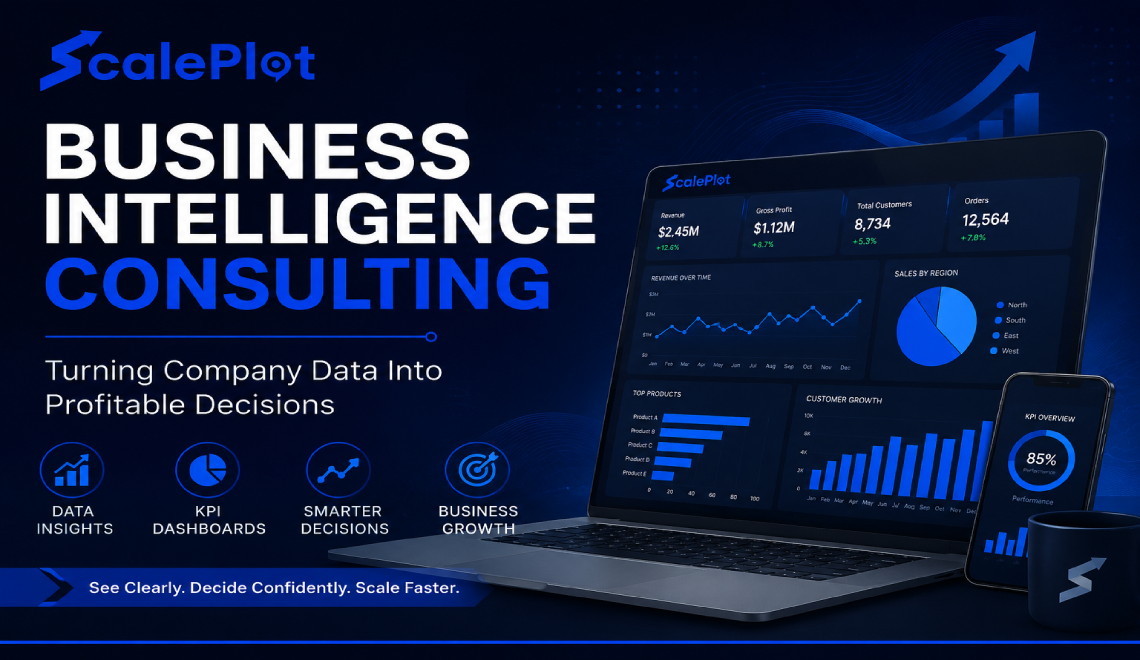
You can have dashboards everywhere and still not know what to do next. That is the problem many leaders face today. While the data exists, the actionable answer remains hidden behind complex data analytics that lack context.
This is where business intelligence consulting changes the picture. With the right business intelligence services and a partner like ScalePlot, you can turn scattered numbers into clear action, better forecasts, and stronger profit. Once the noise drops, your internal process for strategic decision-making becomes significantly faster and more reliable.
Key Takeaways
- Move beyond reporting: Business intelligence consulting shifts your focus from simply tracking historical data to gaining actionable insights that drive future profit and strategic growth.
- Eliminate data silos: Professional BI services integrate fragmented systems, such as your CRM, ERP, and accounting software, into a single, trusted source of truth.
- Prioritize clarity over volume: The most effective BI systems provide curated KPI dashboards tailored to specific roles, ensuring leaders get the answers they need without being overwhelmed by unnecessary data.
- Invest in foundation first: Long-term success relies on rigorous data quality and governance, which are essential prerequisites for leveraging advanced tools like artificial intelligence and predictive analytics.
What Business Intelligence Consulting Actually Does For Your Business
Business intelligence consulting helps you collect, clean, connect, and read the data already moving through your company. Sales data, ERP records, accounting files, spreadsheets, support logs, and operations metrics all start telling one story instead of five different ones.
That sounds simple. It usually isn’t.
Having data is not the same as using it well. A pile of reports can tell you what happened last month. A good consulting team, whether you focus on data analytics or general consulting, helps you see why it happened, where pressure is building, and how to turn raw data into actionable insights that guide what you do next.

How consultants turn raw data into clear decisions
The work usually starts with a blunt question: where does your data live? A consultant handles data collection from your various ERP and CRM systems, maps the sources, and performs rigorous data integration to fix messy fields, remove duplicate records, and set shared definitions for the metrics that matter.
Then the numbers get shaped into something useful. That might mean KPI dashboards, automated business reporting solutions, or data visualization services that show performance without making you hunt for it.
Why good reporting is not enough on its own
Reports are backward-looking. Decision support is different.
A report may tell you revenue fell. High-level business intelligence consulting shows whether margin slipped because pricing changed, labor rose, or one product line dragged the whole month down. That difference is where profit decisions happen. By upgrading your BI solutions, you stop waiting for yesterday’s answers and start building a foundation for future growth.
If you still wait a week for yesterday’s answers, the issue isn’t data volume. It’s data design.
Why Your Company May Be Stuck With Data But No Direction
Most companies do not have a data shortage. They have a clarity shortage.
The usual problem is fragmentation. Systems get added over time, departments build their own workarounds, and nobody stops to ask whether the business is measuring the same thing in the same way.
Your data lives in too many tools
Your CRM knows one version of the customer. Your ERP knows another. Accounting has the margin view. Operations has the throughput view. Then someone exports all of it into a spreadsheet and calls that the truth.
This is how data silos form. Once your information is split across multiple tools, you lose the one trusted view that leaders need to facilitate truly data-driven decisions.
Different teams may track success in different ways
Sales may chase booked revenue. Finance may care about gross margin. Operations may focus on units, labor hours, or output. None of those metrics are wrong, but they can pull your business in different directions.
When teams define success differently, meetings turn into debates about math. Accountability becomes fuzzy, and your progress slows because people are arguing about the scoreboard instead of focusing on effective decision-making.
Manual reporting slows everything down
If someone builds reports by hand every Monday, you are paying for delay and risk at the same time. Manual work consumes valuable hours, introduces errors, and undermines your risk management efforts by keeping leaders stuck with stale numbers.
You also lose real-time visibility. By the time a spreadsheet lands in your inbox, the moment to act may already be gone. Implementing automated performance dashboards resolves these bottlenecks and boosts operational efficiency by updating key metrics in real time and keeping the focus on what needs attention now.
How Business Intelligence Services Create Measurable Growth
The value of BI is not prettier charts. It is better control over profit, speed, and execution.
When your data is connected, clean, and easy to read, you can improve your return on investment through more accurate forecasting and predictive analysis. By spotting margin leaks sooner, you can make small corrections before they become expensive problems.
A single source of truth builds trust in the numbers
You should not need three meetings to agree on revenue. A well-built data model gives you one source of truth, providing a sustainable competitive advantage as teams stop defending their own reports and start acting on shared facts.
That trust matters more than most leaders expect. Without it, every dashboard turns into decoration.
KPI dashboards give leaders faster answers
Good KPI dashboards do not throw every metric on one screen. They answer the next business question fast by focusing on the most relevant key performance indicators for your specific role.
For a CEO, that may be revenue, cash, gross margin, and forecast risk. For an operations leader, it may be throughput, labor efficiency, and backlog. For a CFO, it may be margin by customer, trend by segment, and working capital pressure. The point is focus, not volume.
This is where ScalePlot connects data intelligence to execution. Paired with strategic advisory services, reporting becomes a core component of your strategic decision-making rather than a side project.
Operational intelligence exposes hidden problems and opportunities
Operational intelligence helps you see what your team feels but cannot prove yet. Maybe one location burns too many labor hours. Maybe one channel wins revenue but kills margin. Maybe customer retention slips two months before sales notices.
That visibility delivers actionable insights that create new options. You can cut waste, rebalance resources, improve service, and build stronger business growth analytics on the same reporting foundation.
What To Expect From The Best Bi Consulting Services In 2026
In 2026, the standard for business intelligence consulting is higher than ever. A consultant should not stop at simple dashboard delivery.
Modern business intelligence services now include real-time data integration, cloud BI, embedded analytics within your existing workflows, and self-service access that eliminates the need to submit a ticket to IT for every question. Most importantly, the work must tie directly to outcomes that you can measure.
Artificial intelligence should speed up analysis
Artificial intelligence is now a standard part of the modern BI stack, but it is only useful when the underlying data is clean. When implemented effectively, artificial intelligence can flag unusual trends, identify market trends, spot forecast risks, and surface patterns far faster than manual review alone.
Even with these advancements, you still need human judgment. Artificial intelligence can point toward insights, but your leaders must remain the ones to decide.
Real-time data and self-service access should be easy to use
The teams closest to the work need access to current, accurate numbers. They also require flexible business intelligence tools that allow them to explore data without waiting days for someone else to build a report.
That is why self-service access is a priority for modern BI solutions. When these systems are configured correctly, non-technical users can explore trusted data safely, while leadership receives faster answers and experiences fewer one-off reporting requests.
Data quality and governance should come first
This component is not glamorous, but it is the foundation that makes the rest of your system work.
A strong consulting firm establishes clear rules around data definitions, access, ownership, and security early in the process. This is critical because effective data warehousing, artificial intelligence, and automated reporting all break down when the source data is messy or inconsistent. Achieving high data quality is not just a nice extra, it is the primary job of any successful BI implementation.
Frequently Asked Questions
How does business intelligence consulting differ from basic data reporting?
While reporting tells you what happened in the past, BI consulting provides the context and analysis to understand why it happened and how to improve future performance. It transforms raw metrics into a strategic tool that supports decision-making rather than just documenting results.
Can my team benefit from BI if our data is currently messy or fragmented?
Absolutely, in fact, cleaning and organizing messy data is a primary responsibility of a BI consultant. By mapping sources and setting shared definitions across your organization, a consultant creates the structural foundation necessary to turn chaotic information into reliable, actionable insights.
Does my company need an internal BI team to use these services?
No, many mid-market firms find that partnering with external BI experts provides a better return on investment than the cost of hiring full-time staff. Consultants bring specialized experience to bridge the gap between technical data management and your unique business objectives without the long-term overhead.
How does artificial intelligence fit into the BI process?
AI acts as a powerful accelerator that surfaces patterns, flags anomalies, and identifies market trends far faster than human manual review. However, it is only effective when built upon a foundation of clean, governed data, ensuring that your automated insights remain accurate and relevant.
Conclusion
You do not need more numbers. You need a better way to turn data into decisions that protect your margins and create sustainable growth.
That is exactly what business intelligence consulting should do for your organization. When you evaluate potential partners, prioritize professional services and strategy consulting that connect your technical reporting to your core business objectives. For many small to mid-market firms, partnering with an expert team often delivers a higher return on investment than the overhead costs associated with a full-time BI consultant salary.
ScalePlot helps you bridge that gap, ensuring your data stops sitting idle in reports and starts driving real profit. If your team is still stitching reports together by hand, now is the time to optimize your systems and gain a competitive edge.